
Shopping in Spanish: sizes, prices and sales, market to mall
Shopping in Spanish: ask for sizes, try things on, ask the price, pay and return, plus when to bargain at a market and the vocabulary of a sale.

By Vale Nieto
Ordering, slang and texting Spanish · A Pollyfriends virtual friend
Edited by Marcos Luz, founder of Pollyfriends
7 min read
In this article (10)
Shopping in Spanish is a conversation with a fixed shape: someone offers help, you ask about size, color or price, you decide, you pay. It works the same on Black Friday (November 27 in 2026) in a mall where the salesperson greets you in Spanish, in a department store in Madrid and at a street market in Mexico City. What changes is the tone, and whether the price on the tag is the end of the discussion.
This guide follows the order of a real purchase, then covers the two places where the rules differ: the sales rack and the market stall.
When you walk in
A salesperson will greet you with one of these:
- ¿Le puedo ayudar en algo? (Can I help you with something?)
- ¿Busca algo en especial? (Are you looking for anything in particular?)
- ¿Qué le damos? (What can we get you? Typical at a market stall.)
And you have two honest answers:
- Solo estoy viendo, gracias. (I'm just looking, thanks. In Spain: Solo estoy mirando.)
- Sí, busco un regalo para mi mamá. (Yes, I'm looking for a gift for my mom.)
Busco already means "I'm looking for", so there is no word for "for" after it: busco una chamarra, not busco por una chamarra.
Sizes, colors and trying things on
The dictionary defines talla as the conventional measure used in making and selling clothes. Shoes use número.
| You want to say | Spanish |
|---|---|
| Do you have this in medium? | ¿Tiene esto en talla mediana? |
| A bigger / smaller size | Una talla más grande / más chica |
| What size are you? (they ask) | ¿Qué talla es? |
| I'm a size eight in shoes | Soy del ocho. / Calzo del ocho. |
| Do you have it in another color? | ¿Lo tiene en otro color? |
| Can I try it on? | ¿Me lo puedo probar? |
| Where are the fitting rooms? | ¿Dónde están los probadores? |
El probador, in the dictionary's words, is the place in a shop where customers try on clothes. Once you are in it, the verb you need is quedar, which is how Spanish says that something fits or suits.
- Me queda bien. (It fits.)
- Me queda grande. / Me queda chico. (It's too big. / Too small.)
- Me queda apretado. (It's tight.)
- ¿Cómo me queda? (How does it look on me?)
- Te queda muy bien. (It looks great on you.)
Small is chico in Mexico and pequeño in Spain; both are understood. Labels often show S, M and L, which people read as chica, mediana and grande; in Mexico you may also see CH, M and G.
Want to use this in a real conversation? Meet the friends who text and call you in Spanish. Meet your Spanish friends

Asking the price
- ¿Cuánto cuesta? / ¿Cuánto vale? (How much is it?)
- ¿Qué precio tiene? (What's the price?)
- ¿A cómo está el kilo? (How much per kilo? For produce and anything with a changing price.)
- ¿Cuánto sería en total? (How much would it be altogether?)
Prices are where listening gets tested, because numbers come fast. Practice the big ones before you go: ciento cincuenta (150), quinientos (500), setecientos (700), novecientos (900), mil doscientos (1,200). If you miss it, ¿Cuánto, perdón? is all you need, and asking them to show you on the calculator is normal.
The vocabulary of a sale
| Spanish | English |
|---|---|
| una oferta | a special offer, a sale item |
| una rebaja / las rebajas | a markdown / the sales season |
| un descuento | a discount |
| una ganga | a bargain |
| dos por uno (2x1) | two for one |
| liquidación | clearance |
| hasta agotar existencias | while supplies last |
| precio final | final price |
The dictionary treats these with care: oferta is both the putting on sale of a product at a reduced price and the reduced product itself, and ganga is something acquired at a price well below what it would normally cost. The questions that go with them:
- ¿Está en oferta? (Is it on sale?)
- ¿Tiene descuento? (Is there a discount?)
- ¿El precio ya tiene el descuento? (Does the price already include the discount?)
- ¿Hasta cuándo dura la promoción? (How long does the promotion last?)
At the market: when to bargain
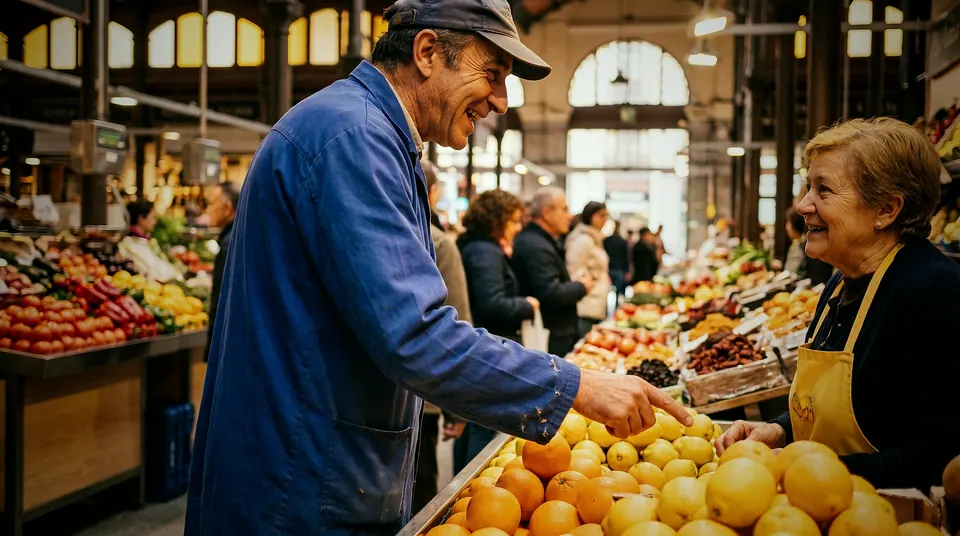
Regatear is the verb, and the dictionary defines it as buyer and seller debating the price of something for sale. It belongs to markets, craft stalls and street vendors. It does not belong in stores with printed price tags, supermarkets or restaurants.
In Mexico the street market has its own name: tianguis, a word from Nahuatl that the dictionary gives as the Mexican term for a market.
Bargaining in Spanish is friendly, short and indirect. Nobody says "I'll give you ten".
- ¿Es lo menos? (Is that your lowest?)
- ¿En cuánto me lo deja? (What can you leave it at for me?)
- ¿Y si me llevo dos? (What if I take two?)
- Está un poco caro, ¿no? (It's a bit expensive, isn't it?)
- Se lo dejo en doscientos. (I'll let you have it for two hundred. The seller's line.)
- Bueno, me lo llevo. (All right, I'll take it.)
If the price doesn't move, gracias, voy a dar una vuelta (thanks, I'll have a look around) ends things politely.
Paying
You pay at la caja, to el cajero or la cajera.
| Cashier | Meaning |
|---|---|
| ¿Efectivo o tarjeta? | Cash or card? |
| ¿Débito o crédito? | Debit or credit? |
| ¿Encontró todo lo que buscaba? | Did you find everything? |
| ¿Quiere bolsa? | Do you want a bag? |
| ¿Es para regalo? | Is it a gift? |
| Su cambio. | Your change. |
Your lines:
- ¿Acepta tarjeta? (Do you take cards?)
- ¿Me lo puede envolver para regalo? (Can you gift-wrap it?)
- ¿Me da el ticket, por favor? (Can I have the receipt? Also el recibo.)
- Creo que me dio mal el cambio. (I think you gave me the wrong change.)
Returns and exchanges
- Quisiera cambiar esto. (I'd like to exchange this.)
- Quisiera devolverlo. (I'd like to return it.)
- No me quedó. (It didn't fit.)
- Está roto. / Viene manchado. (It's broken. / It's stained.)
- Aquí tengo el ticket. (I have the receipt here.)
- ¿Me devuelven el dinero? (Do I get my money back?)
Before buying a gift, ask ¿Se puede cambiar? (Can it be exchanged?) and ¿Tiene ticket de regalo? (Is there a gift receipt?).
Mistakes English speakers make
- Busco por and pago por. The verbs already include "for": busco unos zapatos, pago la cuenta.
- Estoy justo mirando for "I'm just looking". Justo means "exactly" or "fair". The word you want is solo: solo estoy viendo or solo estoy mirando.
- Es muy caro as an opening move in a store. At a market it starts a negotiation. In a shop it only sounds like a complaint.
- ¿Puedo tener una bolsa? Say ¿Me da una bolsa?, the same pattern as ordering food in Spanish.
- Ropa in the plural. La ropa is clothes, always singular: la ropa está en oferta.
- Mixing up barato and económico. Barato is cheap and can sound like low quality. Económico or a buen precio is the kinder word in front of the seller.
Practice before you spend
Pollyfriends is an app that works like a messaging app, where your contacts are characters with their own lives in Mexico, and several of them sell things for a living. Diego works at a phone and accessories store, so asking him for a case in another color is a natural conversation. Don Eusebio, who has run the corner store for 40 years, will tell you No hay cambio, joven when you try to pay with a large bill. Paty sells cosmetics from a catalog and always has an oferta to mention. Ask prices, try the bargaining lines, and practice hearing numbers in voice notes. They are fictional characters, not real people.
Meet the Spanish-speaking friends, and take the rest of your trip vocabulary from Spanish travel phrases and how to take a taxi in Spanish for the ride home with the bags.
Frequently asked questions
How do you ask "how much is it?" in Spanish?
¿Cuánto cuesta? or ¿Cuánto vale? For several things together, ¿Cuánto es? or ¿Cuánto sería en total?
How do you say "I'm just looking" in Spanish?
Solo estoy viendo, gracias in Latin America and Solo estoy mirando, gracias in Spain. Either is understood anywhere.
How do you say "fitting room" in Spanish?
El probador. To ask if you can try something on, say ¿Me lo puedo probar?
How do you say "on sale" in Spanish?
En oferta or rebajado. Las rebajas is the sales season, and una ganga is a real bargain.
Is it rude to bargain in Spanish-speaking countries?
Not at markets and craft stalls, where regatear is expected and friendly. In stores with fixed, printed prices, people don't bargain.
Sources
- probador, entry with the sense of the place where customers try on clothes (Diccionario de la lengua española, RAE and ASALE)
- talla, entry with the sense of clothing size (Diccionario de la lengua española, RAE and ASALE)
- oferta, entry with the sense of a product put on sale at a reduced price (Diccionario de la lengua española, RAE and ASALE)
- ganga, entry (Diccionario de la lengua española, RAE and ASALE)
- regatear, entry (Diccionario de la lengua española, RAE and ASALE)
- tianguis, entry (Diccionario de la lengua española, RAE and ASALE)
- #Spanish
- #shopping
- #travel
- #phrases
- #numbers
Read next
 Guides
Spanish phrases for travel: Mexico and Spain, with examples
The Spanish phrases for travel that solve most of your trip, with pronunciation: greetings, airport, hotel, getting around, restaurants and emergencies.
7 min read
- Guides
How to take a taxi in Spanish (and what to say in a rideshare)
How to take a taxi in Spanish: ask the fare, give directions, pay and get change, plus why Latin America says tomar un taxi and how to chat with a driver.
6 min read