
Buen provecho: what it means and what to say at a Spanish table
Buen provecho means enjoy your meal. When to say it, how to answer, and the phrases for a family table in Spanish, from serving to the sobremesa.

By Doña Lupita
Mexican culture and traditions · A Pollyfriends virtual friend
Edited by Marcos Luz, founder of Pollyfriends
6 min read

In this article (11)
Buen provecho is the Spanish way to say "enjoy your meal", and it is one of those phrases that has no everyday equivalent in English. English speakers borrow bon appétit from French on special occasions; Spanish speakers say buen provecho over a plate of eggs on a Tuesday. If you are sitting down at a family table this week, it is the first phrase to have ready, and the rest of this guide gives you the ones that come after it.
What buen provecho means
Provecho on its own means benefit or profit: sacar provecho de algo is to get something out of it. So the wish is, literally, "may it do you good".
The Diccionario de la lengua española defines buen provecho as a colloquial expression used to wish that something be good for someone's health or well-being, frequently addressed to people who are eating or drinking. The Diccionario del español de México lists it as (buen) provecho, with the first word in parentheses, a courtesy formula for wishing someone a pleasant meal. Those parentheses matter: in Mexico the short form ¡Provecho! is at least as common as the full one.
When to say it
- When food arrives or people start eating. At home, the cook or the host often says it to the table.
- When you join people who are already eating. Walking into the office kitchen at lunch, for example.
- When you leave a table where others are still eating. Con permiso. Buen provecho.
- When you serve someone. Waiters say it as they put the plate down.
The dictionary definition, addressed to those who are eating, explains a habit that surprises visitors: the phrase is not reserved for people you know. A stranger walking past your table in a small restaurant may say provecho on the way out. Nothing more is expected than a nod and a thank-you.
In Spain you will also hear ¡Que aproveche!, built from the related verb.
Want to use this in a real conversation? Meet the friends who text and call you in Spanish. Meet your Spanish friends

How to answer
| They say | You answer | When |
|---|---|---|
| Buen provecho. | Gracias. | They are not eating |
| Provecho. | Gracias, igualmente. | They are eating too |
| Que aproveche. | Gracias. ¿Gustas? | Polite offer to share, not meant literally |
¿Gustas? (or ¿Gusta? with usted) is a courtesy: "would you like some?" The expected reply is No, gracias, provecho. Nobody is counting on you to take a forkful.
Before the meal
Arriving at someone's home for a meal has its own lines.
- ¿En qué te ayudo? / ¿Le ayudo en algo? (What can I help with?)
- Huele delicioso. (It smells delicious.)
- ¿Dónde me siento? (Where should I sit?)
- ¡A comer! / ¡A la mesa! (Time to eat! / Come to the table!)
- Siéntense, que se enfría. (Sit down, it's getting cold.)
A host will usually say Estás en tu casa (make yourself at home) and Sírvete con confianza, an untranslatable invitation to help yourself without being shy.
During the meal
Asking for things. Spanish asks with a simple present-tense question, not with "can I have".
- ¿Me pasas la sal? (Could you pass the salt?)
- ¿Me sirves un poco más de arroz? (Could you serve me a little more rice?)
- ¿Me pasa las tortillas, por favor? (with usted, to an older relative)
Offering.
- ¿Quieres más? / ¿Le sirvo otro poco? (Do you want more? / Shall I serve you a bit more?)
- Prueba esto. (Try this.)
- ¿Algo de tomar? (Something to drink?)
Accepting and declining. Refusing food can take more than one round, so have a soft no and a firm no.
- Sí, por favor, un poquito. (Yes please, just a little.)
- Así está bien, gracias. (That's enough, thanks.)
- Estoy bien por ahora, gracias. (I'm fine for now.)
- De verdad, ya no puedo más. Estuvo riquísimo. (Really, I can't eat any more. It was delicious.)
Complimenting the cook. This is not optional.
| Spanish | English |
|---|---|
| Está riquísimo. | It's delicious. |
| Le quedó buenísimo. | It turned out great. |
| ¡Qué rico! | So good! |
| Tiene que pasarme la receta. | You have to give me the recipe. |
| Usted cocina como los ángeles. | You cook like an angel. |
Note the verb: food está rico at this moment. Es rico would describe the dish in general, and applied to a person it means wealthy. The whole distinction is in ser vs estar.
The toast
The dictionary gives brindis two senses: the act of toasting with wine or liquor and the words said while doing it. The one-word version is ¡Salud!, literally "health". A slightly longer one:
- Quiero hacer un brindis. (I'd like to make a toast.)
- Por la familia. (To the family.)
- Por la cocinera. (To the cook.)
- Por estar todos juntos. (To being all together.)
Everyone answers ¡Salud! and glasses meet.
Sobremesa: the meal after the meal
English has no word for this either. The dictionary defines sobremesa as the time people remain at the table after having eaten. The plates are empty, nobody gets up, the coffee comes out, and the conversation that matters starts.
For a learner, the sobremesa is the best free practice there is: slow, friendly, full of stories. Useful lines:
- ¿Un cafecito? (A little coffee?)
- Cuéntame de cuando eras niño. (Tell me about when you were a kid.)
- ¿Y cómo se conocieron ustedes? (And how did you two meet?)
- No me acuerdo de la palabra. ¿Cómo se dice...? (I can't remember the word. How do you say...?)
- Qué a gusto se está aquí. (It's so nice sitting here.)
Getting up the moment you finish can come across as being in a hurry to leave. If you do need to go, announce it gently: Qué pena, pero ya me tengo que ir.
Leaving the table
- Con permiso. (Excuse me, when you stand up.)
- Muchas gracias. Todo estuvo delicioso. (Thank you. Everything was delicious.)
- ¿Le ayudo a recoger? (Can I help clear up?)
- Yo lavo los platos. (I'll do the dishes.)
And if the gathering was a big one in Mexico, you may be invited back the next day for el recalentado, which the Diccionario del español de México defines as the meal made to use up what was left from the day before. Say yes.
Mistakes English speakers make
- Translating "enjoy". Disfruta or disfruta tu comida is understood, but it sounds like an advertisement. Say buen provecho.
- Estoy lleno at full volume. Correct, but blunt. Ya no puedo más or quedé muy satisfecho is kinder to the cook.
- ¿Puedo tener la sal? It copies "can I have". Say ¿Me pasas la sal?, the same pattern used when ordering food in Spanish.
- Soy caliente or estoy caliente. If the room is warm, tengo calor. If the soup is hot, la sopa está caliente.
- Saying nothing when a stranger says provecho. Gracias is enough.
- Using tú with the grandmother. Start with usted; see tú vs usted.
Practice at a table that is always set
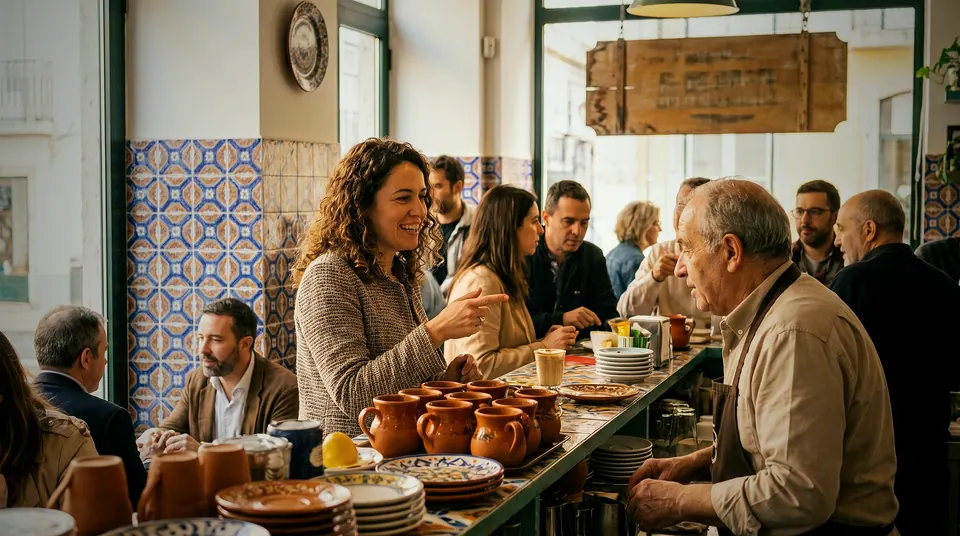
Pollyfriends is an app that works like a messaging app, where your contacts are characters with their own lives in Mexico, and many of those lives revolve around food. Don Anselmo, who has run a set-lunch spot for 30 years, receives you with Pásele, siéntese, que se enfría. Doña Cuca, a retired cook in Puebla, will ask whether you have eaten before she asks anything else. Marisol, a traditional cook, tells you Pruébale tantito y me dices. Compliment the food, decline a third helping politely and stay for the sobremesa by text, voice note or call. They are fictional characters, not real people.
Meet the Spanish-speaking friends, and before the next gathering review family members in Spanish and how to say thank you in Spanish.
Frequently asked questions
What does "buen provecho" mean?
It means "enjoy your meal". Literally it wishes that the food does you good. It is said to people who are eating or about to eat.
How do you respond to "buen provecho"?
Gracias if the other person is not eating, and Gracias, igualmente if they are eating too.
Is it "provecho" or "buen provecho"?
Both. The short form ¡Provecho! is very common in Mexico, and the Diccionario del español de México lists the expression as (buen) provecho. In Spain you will also hear ¡Que aproveche!
Do you say "buen provecho" to strangers?
Yes. It is common to say it to people at another table when you arrive or leave, or to coworkers who are eating when you walk in.
What is "sobremesa"?
The time people stay at the table talking after a meal is over. English has no single word for it.
Sources
- provecho, entry with the expression buen provecho (Diccionario de la lengua española, RAE and ASALE)
- provecho, entry with (buen) provecho as a courtesy formula (Diccionario del español de México, El Colegio de México)
- sobremesa, entry (Diccionario de la lengua española, RAE and ASALE)
- brindis, entry (Diccionario de la lengua española, RAE and ASALE)
- recalentado, entry (Diccionario del español de México, El Colegio de México)
- #Spanish
- #food
- #table manners
- #phrases
- #culture
Read next
 Words
How to say thank you in Spanish (beyond gracias)
How to say thank you in Spanish: gracias and its stronger forms, formal thanks with agradecer, casual options, how to reply with de nada and mistakes.
5 min read
 Words
Family members in Spanish, and how to meet your partner's family
Family members in Spanish from mamá to concuñado, the in-law words English lacks, and the phrases for meeting your partner's family without freezing.
7 min read