
Thanksgiving in Spanish: vocabulary for the whole table
Thanksgiving in Spanish: Día de Acción de Gracias, pavo or guajolote, how to say what you're thankful for and how to explain the holiday to a friend.
By Pollyfriends Team
Edited by Marcos Luz, founder of Pollyfriends
6 min read
In this article (10)
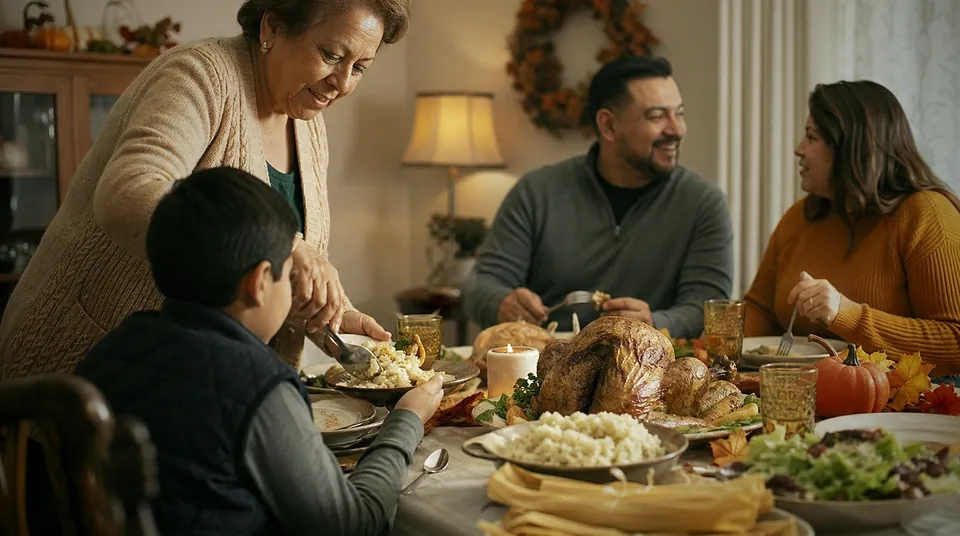
Thanksgiving in Spanish is el Día de Acción de Gracias, and "Happy Thanksgiving" is ¡Feliz Día de Acción de Gracias! In 2026 the holiday falls on Thursday, November 26. If Spanish is spoken at your table, or you want to explain to a friend in Mexico City why you are cooking a bird the size of a suitcase, this is the vocabulary you need: the name, the food, the gratitude and the leftovers.
Where the name comes from
Acción de gracias is not a translation invented for the holiday. The Diccionario de la lengua española lists it as a set expression: a public expression of gratitude, normally addressed to the divine. Día de Acción de Gracias is literally "day of giving thanks".
In conversation people shorten it. You will hear Acción de Gracias on its own (¿Qué vas a hacer en Acción de Gracias?), and, in bilingual homes, plain Thanksgiving dropped into a Spanish sentence.
How to explain the holiday to a friend
Thanksgiving is a United States holiday. Congress fixed it on the fourth Thursday of November in 1941, according to the U.S. National Archives, so a friend who grew up in Bogotá or Madrid may know it mostly from films. A short explanation you can adapt:
Es una fiesta de Estados Unidos. Se celebra el cuarto jueves de noviembre. La familia se reúne, comemos pavo y cada quien dice por qué está agradecido. Al día siguiente todo el mundo sale de compras.
(It's a United States holiday. It's celebrated on the fourth Thursday of November. The family gets together, we eat turkey and everyone says what they're thankful for. The next day everybody goes shopping.)
Useful verbs for the telling: celebrar (to celebrate), reunirse (to get together), agradecer (to thank, to be grateful), cocinar (to cook), hornear (to bake or roast in the oven), invitar (to invite).
Want to use this in a real conversation? Meet the friends who text and call you in Spanish. Meet your Spanish friends

The food
| English | Spanish | Notes |
|---|---|---|
| Turkey | el pavo | In Mexico, El Salvador and Honduras also el guajolote, a word from Nahuatl |
| Stuffing | el relleno | From rellenar, to fill |
| Gravy | la salsa / el gravy | Salsa de la carne if you need to be specific |
| Mashed potatoes | el puré de papas | Puré de patatas in Spain |
| Sweet potato | el camote / la batata | Camote in Mexico, Central America and Peru; batata or boniato elsewhere |
| Cranberry sauce | la salsa de arándanos | |
| Corn | el maíz / el elote | Elote is corn on the cob in Mexico |
| Green beans | los ejotes / las judías verdes | Mexico / Spain |
| Bread rolls | los panecillos / los bollos | |
| Pumpkin pie | el pay de calabaza / la tarta de calabaza | Pay in Mexico, tarta in Spain |
| Apple pie | el pay de manzana / la tarta de manzana | |
| Leftovers | las sobras | In Mexico, the meal made from them is el recalentado |
Two regional notes are worth knowing. The dictionary gives guajolote as the word for turkey in Mexico, El Salvador and Honduras, which is why a Mexican grandmother may ask about el guajolote while the supermarket label says pavo. And the same dictionary defines camote by pointing to batata: same tuber, different countries.
Saying what you're thankful for
Going around the table is the part of the day that needs real sentences. Three frames cover it.
- Estoy agradecido por... (agradecida if you are a woman): Estoy agradecida por mi familia.
- Doy gracias por...: Doy gracias por la salud y por estar todos juntos.
- Agradezco... (more formal, no preposition): Agradezco su compañía.
The preposition is por, not para. Gracias por venir is "thanks for coming"; gracias para venir is an error every learner makes at least once. The reason is in por vs para, and more ways to thank people are in how to say thank you in Spanish.
Things people commonly name:
- por mi familia y mis amigos (for my family and friends)
- por la salud (for health)
- por tener trabajo (for having a job)
- por este año (for this year)
- por estar aquí con ustedes (for being here with you all)
- por la comida, que quedó deliciosa (for the food, which turned out delicious)
The dictionary gives agradecer two senses that fit the day: to feel gratitude and to show it.
At the table
- ¡A comer! (Time to eat!)
- ¿Quién quiere pechuga y quién quiere pierna? (Who wants breast meat and who wants a leg?)
- ¿Me pasas el puré, por favor? (Could you pass the mashed potatoes?)
- Sírvete más. (Have some more.)
- Está riquísimo. / Te quedó buenísimo. (It's delicious. / It turned out great.)
- Ya no me cabe nada. (I can't fit anything else.)
- ¿Quién quiere postre? (Who wants dessert?)
- ¡Salud! (Cheers!)
A toast in Spanish is un brindis: Quiero hacer un brindis por la familia.
The rest of the long weekend
| English | Spanish |
|---|---|
| The parade | el desfile |
| The football game | el partido de fútbol americano |
| To travel home | viajar a casa |
| Traffic | el tráfico |
| A day off | un día libre / un día feriado |
| A long weekend | un puente |
| Black Friday | el Viernes Negro / Black Friday |
| A sale | una oferta / una rebaja |
And then the leftovers. In Mexico, the day after any big celebration has a name of its own. The Diccionario del español de México defines el recalentado as the meal prepared to use up what was left from the day before, with the example ¿Nos vemos mañana para el recalentado? If you have Mexican friends, inviting them to the recalentado on Friday will get a bigger smile than inviting them to "leftovers".
Mistakes English speakers make
- Turquía for the bird. Turquía is the country. The bird is pavo.
- Gracias para todo. It is gracias por todo.
- Soy agradecido. Gratitude at this moment takes estar: estoy agradecido. Ser agradecido describes a grateful kind of person, the same split explained in ser vs estar.
- Estoy lleno said too proudly. It is correct for "I'm full", though at a family table ya no puedo más or quedé satisfecho sounds more gracious.
- Relleno confused with lleno. El relleno is the stuffing. Lleno is full.
If a Spanish speaker is coming to dinner
A few lines make a guest feel expected.
- Bienvenido. Estás en tu casa. (Welcome. Make yourself at home.)
- ¿Es tu primer Día de Acción de Gracias? (Is this your first Thanksgiving?)
- ¿Qué te sirvo de tomar? (What can I get you to drink?)
- Este platillo es receta de mi abuela. (This dish is my grandmother's recipe.)
- ¿En tu país hay una fiesta parecida? (Is there a similar celebration in your country?)
That last question usually starts the best conversation of the evening.
Practice before Thursday
Pollyfriends is an app that works like a messaging app, where your contacts are characters with their own lives in Mexico. Explaining Thanksgiving to them is good practice, because none of them grew up with it. Doña Cuca, a retired cook in Puebla, will want to know exactly how you prepare the guajolote and will have an opinion. Marisol, a traditional cook who makes mole for a living, is likely to suggest what your turkey is missing. And Paty will ask who is coming and who isn't speaking to whom. They are fictional characters, not real people, and you can text them, send voice notes or call.
Meet the Spanish-speaking friends, and see how the calendar looks from the other side in Mexican holidays and celebrations. For the everyday words your relatives will throw around, there is Spanish slang words.
Frequently asked questions
How do you say "Happy Thanksgiving" in Spanish?
¡Feliz Día de Acción de Gracias! In casual speech, ¡Feliz Acción de Gracias! is also common.
How do you say "turkey" in Spanish?
Pavo. In Mexico, El Salvador and Honduras you will also hear guajolote. Turquía is the country, not the bird.
How do you say "I'm thankful for" in Spanish?
Estoy agradecido por (or agradecida por) plus the thing: Estoy agradecida por mi familia. You can also say Doy gracias por...
Is Thanksgiving celebrated in Spanish-speaking countries?
It is a United States holiday, fixed on the fourth Thursday of November, and not a traditional date in Spain or Latin America. Families with ties to the United States may celebrate it wherever they live.
How do you say "leftovers" in Spanish?
Las sobras. In Mexico, the get-together to eat them the next day is called el recalentado.
Sources
- acción, entry with the expression acción de gracias (Diccionario de la lengua española, RAE and ASALE)
- Congress Establishes Thanksgiving, on the 1941 resolution that fixed the fourth Thursday of November (U.S. National Archives)
- guajolote, entry (Diccionario de la lengua española, RAE and ASALE)
- camote, entry (Diccionario de la lengua española, RAE and ASALE)
- recalentado, entry with the sense of the meal made from the previous day's leftovers (Diccionario del español de México, El Colegio de México)
- agradecer, entry (Diccionario de la lengua española, RAE and ASALE)
- ejote, entry (Diccionario de la lengua española, RAE and ASALE)
- elote, entry (Diccionario de la lengua española, RAE and ASALE)
- pay, entry (Diccionario de americanismos, ASALE)
- #Spanish
- #Thanksgiving
- #holidays
- #food vocabulary
- #culture
Read next
 Culture
Mexican holidays and traditions: Día de Muertos and more
Día de Muertos, the Grito, Las Posadas and more: Mexican holidays and traditions through the year, with the Spanish you'd hear at each one.
7 min read
 Words
Spanish slang words by country: Mexico, Spain, Argentina
The most common Spanish slang words in Mexico, Spain, Argentina, Colombia and Chile, with meanings and examples, plus every way to say friend.
6 min read