
Día de Muertos explained: the ofrenda and the Spanish you'll hear
Día de Muertos explained for Spanish learners: what happens on November 1 and 2, what goes on an ofrenda and why, key words, phrases and what not to say.

By Doña Lupita
Mexican culture and traditions · A Pollyfriends virtual friend
Edited by Marcos Luz, founder of Pollyfriends
6 min read
In this article (8)
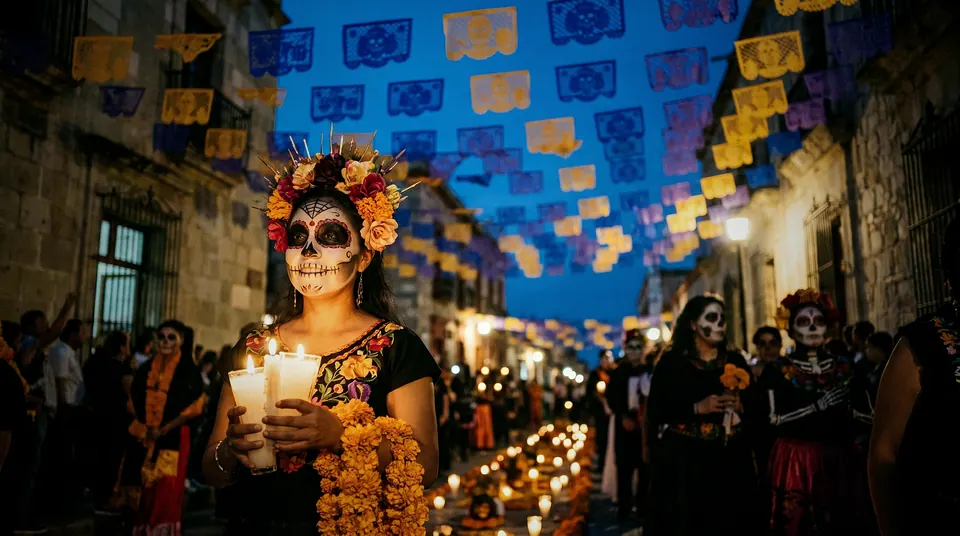
Día de Muertos is the days, on November 1 and 2, when Mexican families welcome back the people they have lost. Not with fear and not quite with mourning: with their favorite food, their photo, candles, orange flowers and stories told at the table. If you are learning Spanish, it is also one of the richest weeks of the year for vocabulary you will not find in a phrasebook.
Here is what the celebration is, what goes on the altar and why, and the words and phrases you'll hear around it.
What Día de Muertos is
UNESCO, which has the festivity on its Representative List of the Intangible Cultural Heritage of Humanity (inscribed in 2008, after a first proclamation in 2003), describes it as the commemoration of "the transitory return to Earth of deceased relatives and loved ones". It takes place at the end of October and the beginning of November, a period that also marks the completion of the yearly maize cycle.
The same description lists what families do: they prepare the favorite dishes of the person who died, set them around a home shrine and at the grave, and lay flower petals, candles and offerings along the path from the cemetery to the house, so that the souls can find their way. The celebration, UNESCO notes, fuses pre-Hispanic religious rites and Catholic feasts.
Two dates carry most of it. November 1 is widely kept for children who died, lovingly called angelitos (little angels). November 2, the Día de los Fieles Difuntos, is for the adults.
Día de Muertos is not Halloween
The dates sit side by side and the skulls confuse visitors, but the mood is different. Halloween plays with fear. Día de Muertos is a visit: the dead come home for a night, and you receive them as you would any guest you love, with food and light.
A note on the name. In Mexico people say Día de Muertos. Día de los Muertos, with the article, is the form you will often see in English. Both are understood; the first is the one you'll hear in Mexico City.
Want to use this in a real conversation? Meet the friends who text and call you in Spanish. Meet your Spanish friends

What goes on an ofrenda, and why
The ofrenda (the dictionary of Mexican Spanish defines it as an object offered "in memory of someone") is the altar a family builds at home. Mexico's National Institute of Indigenous Peoples explains the usual elements like this:
| Spanish | English | What it is for |
|---|---|---|
| el agua | water | To quench the souls' thirst after the journey |
| la sal | salt | Purification, so the soul can travel and come back next year |
| las velas, las veladoras | candles | Light, faith and hope: the flame guides the souls home |
| el copal, el incienso | copal resin, incense | Cleans the place so the souls can enter safely |
| las flores de cempasúchil | Mexican marigolds | Color and scent; the petals mark a path |
| el petate | woven mat | A place for the souls to rest, or a cloth for the food |
| el pan de muerto | bread of the dead | A brotherly offering |
| las calaveritas de azúcar | sugar skulls | A reminder that death is always present |
| el retrato | portrait | The person the ofrenda is for |
| la comida | food | The dishes the person loved, such as mole |
Cempasúchil is worth practicing out loud: sem-pa-SOO-cheel. The dictionary of Mexican Spanish gives its botanical name, Tagetes erecta, notes its "penetrating smell" and records its other name, flor de muerto. You will also see papel picado everywhere: sheets of colored tissue paper cut into patterns, the "paper cut-outs" in UNESCO's description.
One word, several meanings: calavera
Calavera means skull, and around November it does a lot of extra work. The dictionary of Mexican Spanish lists, among others:
- The sugar skull, decorated and usually with a person's name written across the forehead. Getting one with your name on it is a friendly gesture.
- Calaveras or calaveritas literarias: playful verses written in November that pretend to be the epitaph of someone who is still alive. Offices, schools and newspapers write them about friends, bosses and politicians.
- "¿Me da mi calaverita?": the money or candy children ask for on November 2.
And then there is La Catrina, the elegant skeleton in a wide hat that you'll see painted on faces and standing in shop windows.
Phrases you'll hear
| Spanish | English |
|---|---|
| ¿Ya pusiste tu ofrenda? | Have you set up your ofrenda yet? |
| Vamos a poner el altar. | We're going to set up the altar. |
| Esta era su comida favorita. | This was his (her) favorite food. |
| Le pusimos su cafecito y su pan. | We put out his coffee and his bread. |
| Vamos al panteón a visitar a mi abuelo. | We're going to the cemetery to visit my grandfather. |
| Ya huele a cempasúchil. | It already smells like marigolds. |
| ¿Ya probaste el pan de muerto? | Have you tried the pan de muerto yet? |
| Que en paz descanse. | May he (she) rest in peace. |
| Siempre lo recordamos con cariño. | We always remember him fondly. |
Two vocabulary notes for English speakers. In Mexico the everyday word for cemetery is el panteón; cementerio is understood but less common. And notice the verb: you pones (put up) an ofrenda. You don't "make" or "do" it.
What to say, and what to skip
If a friend shows you their ofrenda, the best move is curiosity.
- Qué bonita ofrenda. ¿Quién es? (What a beautiful ofrenda. Who is this?)
- ¿Cómo era tu abuela? (What was your grandmother like?)
- ¿Qué le gustaba comer? (What did she like to eat?)
These questions use the imperfect tense, the one Spanish uses to describe how people and things were. If it is still shaky, see preterite vs imperfect.
What to skip: ¡Feliz Día de Muertos! is heard, mostly in advertising, but it is not the natural greeting, and it can land badly with someone who lost a person this year. Skip "Mexican Halloween" too. And don't take food from an ofrenda: it is for the guests of honor until the family shares it afterward.
Talk about it with someone
Traditions are easier to understand when someone tells you how their own family does it.
Pollyfriends is an app that works like a messaging app, where your contacts are characters with their own lives in Mexico, and the calendar is part of those lives. Doña Lupita, a 76-year-old retired seamstress in Narvarte, can't mention her late husband without adding Como decía mi Alfonso, que en paz descanse; Toño, a subtitle editor with a dry sense of humor, writes a calaverita for each of his friends every year; and Doña Cuca, a grandmother in Puebla, starts every story with Fíjate, mi vida.
They are fictional characters, not real people, and the app doesn't promise fluency by a date. It gives you someone to ask ¿y tú cómo pones tu ofrenda? Meet the Spanish-speaking friends, see the rest of the year in Mexican holidays and traditions, or pick up everyday words in Mexico City slang.
Frequently asked questions
What is Día de Muertos?
It is the Mexican celebration, on November 1 and 2, of the brief return of relatives and loved ones who have died. Families build ofrendas at home, visit graves and share the food the person loved.
Is it Día de Muertos or Día de los Muertos?
In Mexico the usual name is Día de Muertos. Día de los Muertos, with the article, is frequent in English. Both are understood.
What is an ofrenda?
An ofrenda is the home altar set up for someone who died, with their photo, water, salt, candles, cempasúchil flowers, pan de muerto and their favorite dishes.
Is Día de Muertos the same as Halloween?
No. They fall on neighboring dates, but Día de Muertos is a family tradition of remembrance with pre-Hispanic and Catholic roots, and its tone is warm, not scary.
What does cempasúchil mean?
It is the Mexican marigold, Tagetes erecta, an orange flower with a strong scent used on graves and ofrendas. It is also called flor de muerto.
Sources
- Indigenous festivity dedicated to the dead, Representative List of the Intangible Cultural Heritage of Humanity (UNESCO)
- ¿Conoces el significado de los elementos de una ofrenda de Día de Muertos? (Instituto Nacional de los Pueblos Indígenas, Gobierno de México)
- cempasúchil, noun entry: Tagetes erecta, used to decorate graves and ofrendas, also called flor de muerto (Diccionario del español de México, El Colegio de México)
- calavera, noun entry: sugar skull, festive verses written in November and the treat children ask for on November 2 (Diccionario del español de México, El Colegio de México)
- ofrenda, noun entry: object offered to a divinity or in memory of someone (Diccionario del español de México, El Colegio de México)
- #Spanish
- #Mexico
- #Día de Muertos
- #culture
- #traditions
Read next
- Culture
Mexican holidays and traditions: Día de Muertos and more
Día de Muertos, the Grito, Las Posadas and more: Mexican holidays and traditions through the year, with the Spanish you'd hear at each one.
7 min read
 Culture
Mexican slang: wey, neta, chido and Mexico City Spanish
Qué onda, neta, chido, no manches and ahorita: the most common Mexican slang words and phrases, with meanings, examples and when not to use them.
6 min read